

Current Auction
"Pergamon Moon Globe"
Subject: Globes, Moon
Period: 1980 (circa)
Publication:
Color: Printed Color
Size:
20 x 19.5 inches
50.8 x 49.5 cm
Download High Resolution Image
(or just click on image to launch the Zoom viewer)
(or just click on image to launch the Zoom viewer)
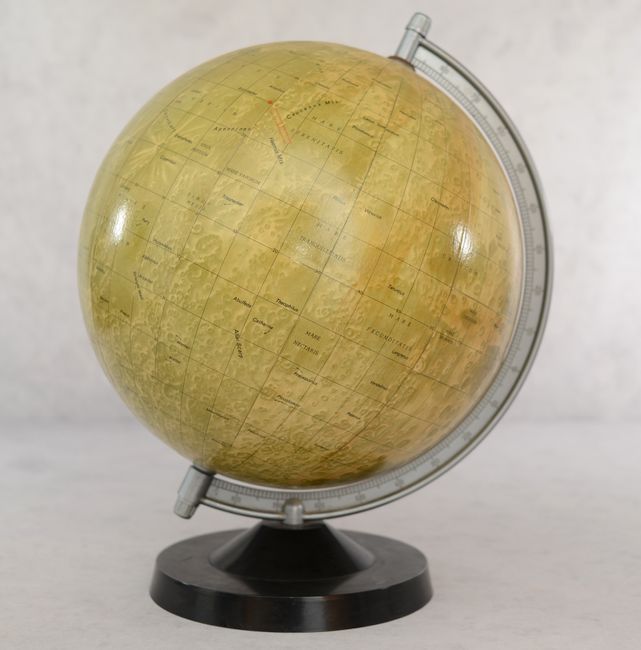
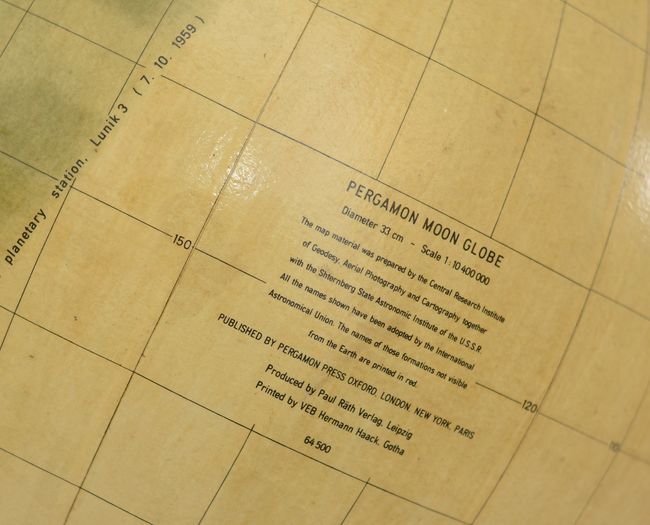
This is a facsimile edition of the remarkable Pergamon lunar globe originally published circa 1963. The globe is based on observations made by the Soviet spacecraft Luna 3 on October 7, 1959. The probe took the first photographs of the far side of the Moon, 29 images in total. On November 6th, 1960, the Academy of Sciences of the Soviet Union published the images in an atlas of the far side of the Moon. A year later, the first globe covering these previously unknown regions was published in the Soviet Union. The English-language Pergamon globe was likely published a couple years later. It was an international production, produced and printed in East Germany by globemaker Paul Rath Verlag (Leipzig) and cartographer VEB Hermann Haack (Gotha), and published by Pergamon Press, with offices in Oxford, London, New York, and Paris. According to the cartouche, the cartography was "prepared by the Central Research Institute of Geodesy, Aerial Photography and Cartography together with the Shternberg State Astronomic Institute of the U.S.S.R."
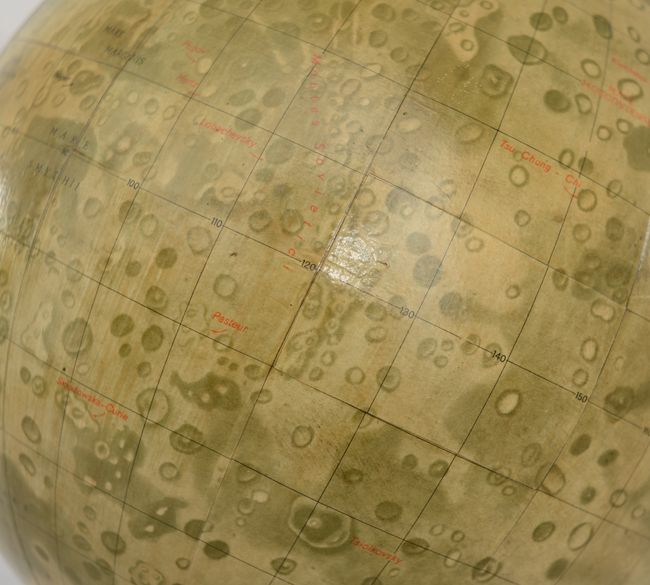
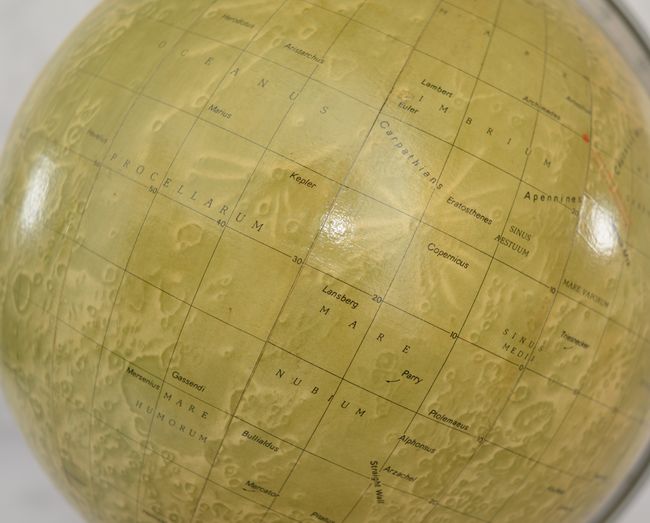
Previously unexplored regions are labeled in red, including Mare Moscoviense, Montes Sovietici, and the craters Edison, Curie, Popov, Pasteur, Mendeleev, and Jules Verne. A dividing line delineates the "limit of the area photographed by the automatic planetary station, Lunik 3 (7. 10. 1959)," with two blank gores representing the remote, unphotographed regions. The point of impact of Luna 2 on September 13, 1959 is marked near Mare Serenitatis; this commemorates the first time a human-made object reached a celestial body.
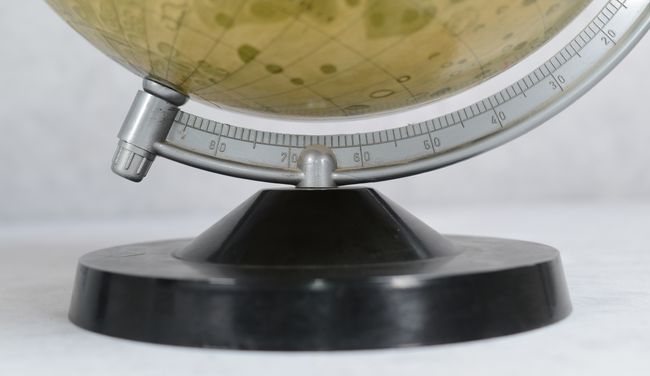
The globe measures 13" (33 cm) in diameter. Scale is 1:10,400,000. This example features an attractive original black plastic base with a plastic meridian ring.
References:
Condition: B+
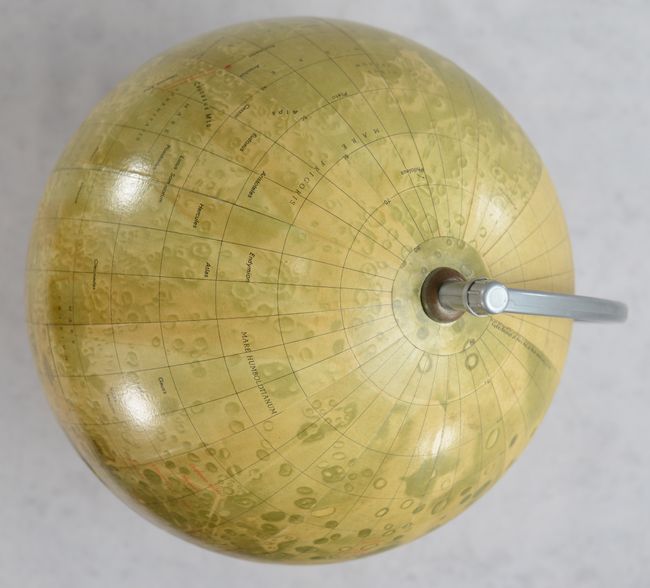
An attractive and functioning globe with light toning, light soiling, and a small abrasion in Mare Imbrium. The base has a minor scuff, and the metal piece protecting the bearing pin at top is lightly rusted.
Estimate: $550 - $700
Price: $400
Bid Increments
$250 - $499$25
$500 - $999$50
$1,000 - $2,499$100
$2,500 - $4,999$250
Terms & Conditions