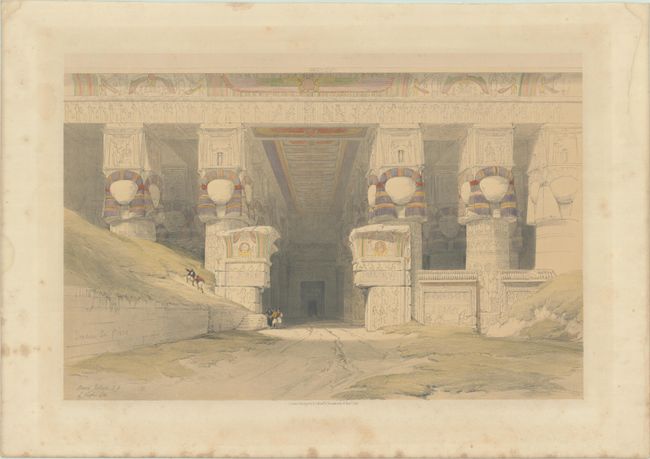
Subject: Temple of Hathor, Dendera, Egypt
Period: 1847 (dated)
Publication: The Holy Land, Syria, Idumea, Arabia, Egypt, & Nubia
Color: Hand Color
Size:
19.4 x 12.9 inches
49.3 x 32.8 cm
The Scottish painter David Roberts, R.A. (1796-1864) was one of the first Europeans to depict the Middle East. Considered a dangerous and barbaric land, it was not until the Napoleonic invasion of Egypt after 1798 that any serious study had been done into the Pharaonic culture. Sir Richard Burton's infamous penetration of Mecca did not occur until 1858, twenty years after Roberts painted the wonders of the Muslim world and the Holy Land. The sketchbooks from Roberts' journeys were one of the most popular publications of its time, allowing Victorian Europeans a peek into the exotic world from the comfort of their parlors.
This stunning lithograph depicts the face of the Hathor temple in the Dendera Temple complex. Construction on the temple as it exists today began during the late Ptolemaic period, when Egypt was ruled by the Greeks, and was completed under the rule of the Roman emperor Trajan. The Romans were responsible for this magnificent gateway, with its massive columns, hieroglyphs, and carvings. The giant faces of the goddess Hathor that appear at the top of the columns were defaced by early Christians. Roberts indicates the impressive scale of the temple by including figures near the entrance. Produced in the tinted lithograph process and finished by hand with watercolor. Published by F.G. Moon. The work was included in the fourth volume of Roberts's The Holy Land, Syria, Idumea, Arabia, Egypt, & Nubia (1842-49).
References:
Condition: B+
On a sturdy and lightly toned sheet with marginal foxing and dampstaining. Remnants of hinge tape on verso.