Subject: Venezuela, Natives
Period: 1617-31 (published)
Publication:
Color: Hand Color
Size:
6.9 x 5.9 inches
17.5 x 15 cm
This copper engraving is from a remarkable series of publications, illustrating voyages of discovery and travels of exploration to various parts of the world. The project was begun by Theodore de Bry of Frankfurt, in 1590 and was to continue for another 54 years. They became known collectively as the Grands Voyages (to America and the West Indies) and the Petits Voyages (to the Orient and the East Indies). De Bry died after the first six parts of the Grands Voyages were completed. The project was completed initially by his widow and two sons, Johann Theodore de Bry and Johann Israel de Bry, then by Johann Theodore's son-in-law, Matthaus Merian, in 1624.
This lot features three plates on two sheets, all originally published in Part X of De Bry's Grands Voyages::
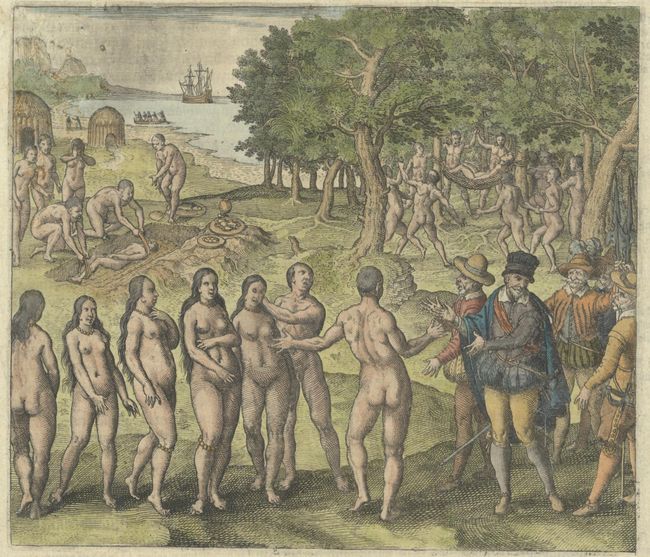
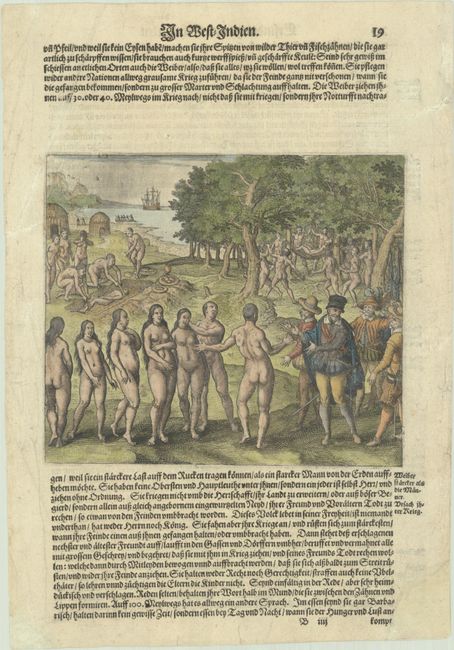
A. [Amerigo Vespucci Visits Paria], from America, das ist / Erfindung ... Der Newen Welt..., published 1617 (6.9 x 6.0"). This engraving of Vespucci encountering the Indigenous people of Paria was apparently drawn from accounts in his letters. In the foreground, Vespucci and his men are offered the Indigenous women. The background shows natives dancing around a sick person in a hammock, while a burial is depicted to the left. Published in a compendium of De Bry's engravings of the Americas put out by his heir, Johann Theodore de Bry. On a sheet of German text measuring 8.6 x 12.3". Condition: There is minor soiling in the top left corner of engraved image and small chips in the bottom corners that have been replaced with archival materials.
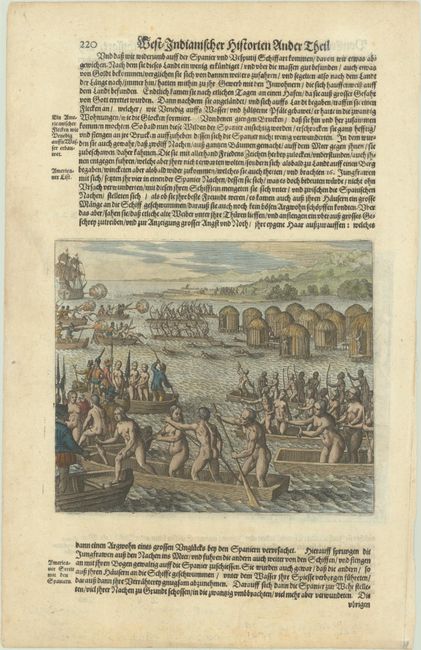
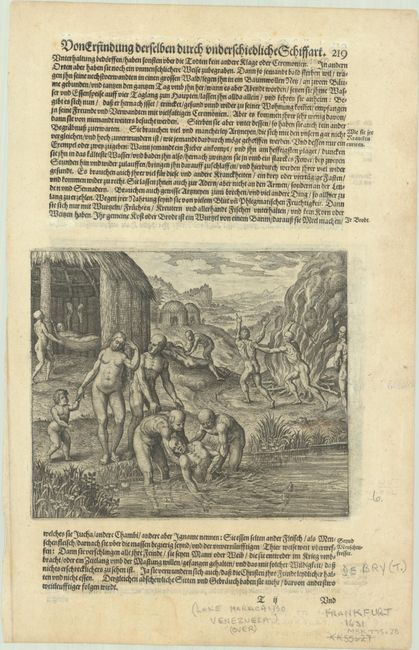
B. [Vespucci Reaches Lake Maracaibo] [on verso] [How the Natives of Paria Coped with Illness], from Historia Antipodum oder Newe Welt…, published 1631 (6.9 x 5.9"). This engraving depicts a village built in the middle of a body of water, with huts built upon poles in the water and bridges linking the huts together. Explorers Alonso de Ojeda, from Spain, and Amerigo Vespucci, from Italy, arrived in Venezuela in 1499 and discovered these fascinating floating villages. The floating villages were located near the Paraguana Peninsula, possibly within Lake Maracaibo. Vespucci was said to have noted that the village reminded him of the city of Venice (or Venezia in Italian), which gave the area its name of Venezuela, meaning Little Venice. The adjacent text explains that the natives initially sent young women in canoes as an offering to the explorers, but then the native men began shooting the Spanish with arrows and throwing spears, forcing the Spaniards to return fire. On verso is an image of how natives in Paria coped with illness. Those with a high fever were first bathed in a cold stream for two hours, then chased around a blazing fire until they were completely dry, and finally put to bed. The plates were republished in Johann Ludwig Gottfried's Historia Antipodum, an abridgement of De Bry's voyages to America that incorporated much new material. Matthaus Merian, de Bry's son-in-law and publisher for Historia Antipodum, was granted access to de Bry's copper-engraved plates. On a full sheet of German text measuring 9.0 x 13.9". Condition: There is mariginal soiling and dampstaining.
References:
Condition: A
See description above.