Subject: Brazil, Natives
Period: 1631 (published)
Publication: Newe Welt und Americanische Historien...
Color: Hand Color
Size:
7.8 x 6.5 inches
19.8 x 16.5 cm
This copper engraving is from a remarkable series of publications, illustrating voyages of discovery and travels of exploration to various parts of the world. The project was begun by Theodore de Bry of Frankfurt, in 1590 and was to continue for another 54 years. They became known collectively as the Grands Voyages (to America and the West Indies) and the Petits Voyages (to the Orient and the East Indies). De Bry died after the first six parts of the Grands Voyages were completed. The project was completed initially by his widow and two sons, Johann Theodore de Bry and Johann Israel de Bry, then by Johann Theodore's son-in-law, Matthaus Merian, in 1624.
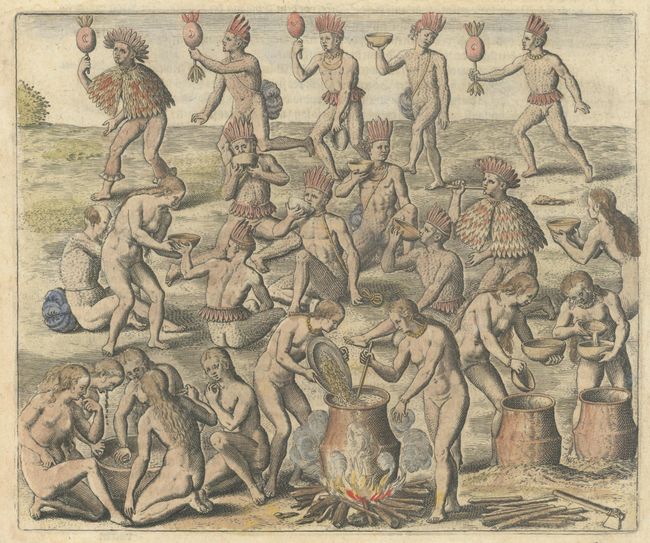
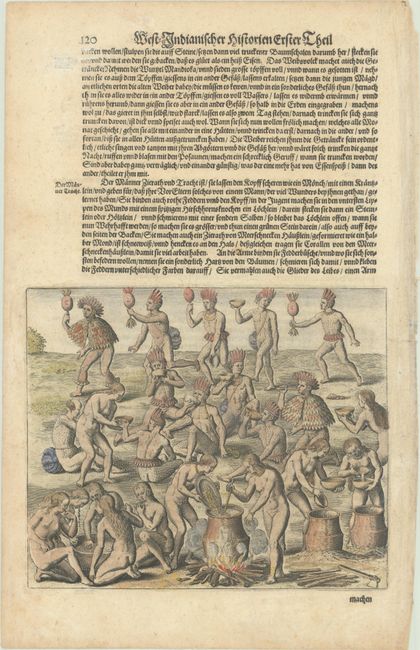
This striking engraving was originally published in Part III of De Bry's Grands Voyages (1592), which focuses on Brazil with accounts by Hans Staden and Jean de Léry. It documents the process of making an intoxicating beverage from the manioc or cassava root. Along the bottom of the engraving, the Tupinamba women boil the roots, chew them up, boil them again, and then let them ferment in barrels. (The process will look familiar to anyone who has seen Hondius's famous map of the Americas.) Above them the men get drunk on the concoction and celebrate. The engraving is based on a description in Hans Staden's account of his adventures in Brazil between 1546-55. The plate was republished in Johann Ludwig Gottfried's Newe Welt und Americanische Historien, a collection of voyages. Also known as Historia Antipodum, Gottfried's work is an abridgement of de Bry's voyages to America that incorporates much new material. Matthaus Merian, de Bry's son-in-law and publisher for Historia Antipodum, was granted access to de Bry's copper-engraved plates. On a sheet of German text measuring 9.0 x 14.0".
References: Van Groesen (De Bry's America) p. 178.
Condition: A
On a faintly toned sheet with a minor spot in engraved image and faint dampstaining that is only visible outside image.