Subject: Mexico City, Mexico, Natives
Period: 1631 (published)
Publication: Newe Welt und Americanische Historien...
Color: Hand Color
Size:
7.4 x 5.8 inches
18.8 x 14.7 cm
This copper engraving is from a remarkable series of publications, illustrating voyages of discovery and travels of exploration to various parts of the world. The project was begun by Theodore de Bry of Frankfurt, in 1590 and was to continue for another 54 years. They became known collectively as the Grands Voyages (to America and the West Indies) and the Petits Voyages (to the Orient and the East Indies). De Bry died after the first six parts of the Grands Voyages were completed. The project was completed initially by his widow and two sons, Johann Theodore de Bry and Johann Israel de Bry, then by Johann Theodore's son-in-law, Matthaus Merian, in 1624.
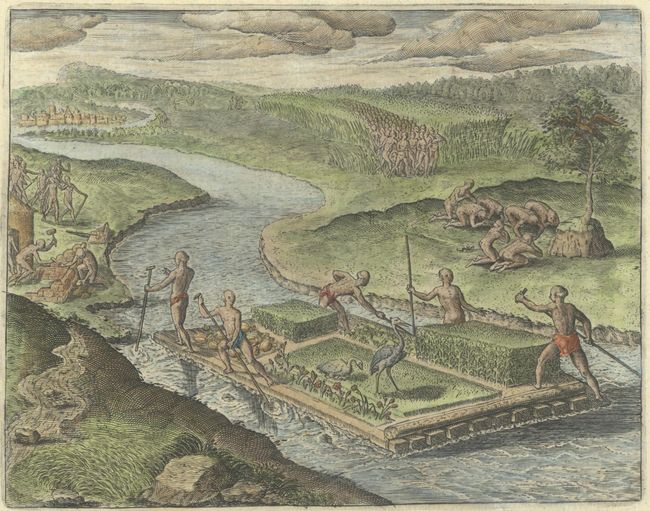
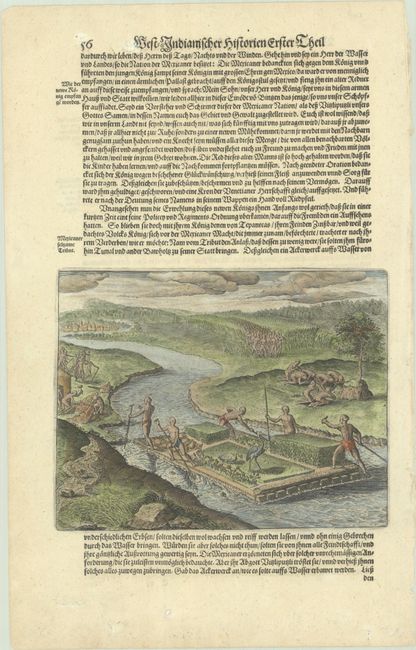
This unusual engraving originally appeared as Plate XII in Part IX of de Bry's Grands Voyages. The engraving illustrates the mythical origin of Tenochtitlan, which later became Mexico City. As depicted here, the Aztecs wandered through desolate regions until coming across Tunal, a prickly pear tree with an eagle clutching a smaller bird at top, as prophesied by their god Vitzliputzli. This area then flourished into Mexico City. In the foreground is a garden of maize and peas where storks and geese roam; this represents the Aztec's taxes to their chief. The plate was republished in Johann Ludwig Gottfried's Newe Welt und Americanische Historien, a collection of voyages. Also known as Historia Antipodum, Gottfried's work is an abridgement of de Bry's voyages to America that incorporates much new material. Matthaus Merian, de Bry's son-in-law and publisher for Historia Antipodum, was granted access to de Bry's copper-engraved plates. On a sheet of German text measuring 9.1 x 14.4".
References: Van Groesen (De Bry's America) p. 346.
Condition: A
A nice impression with a small wormhole in the bottom blank margin that has been infilled with archival materials.