Subject: World
Period: 1641 (dated)
Publication:
Color: Hand Color
Size:
21.6 x 15 inches
54.9 x 38.1 cm
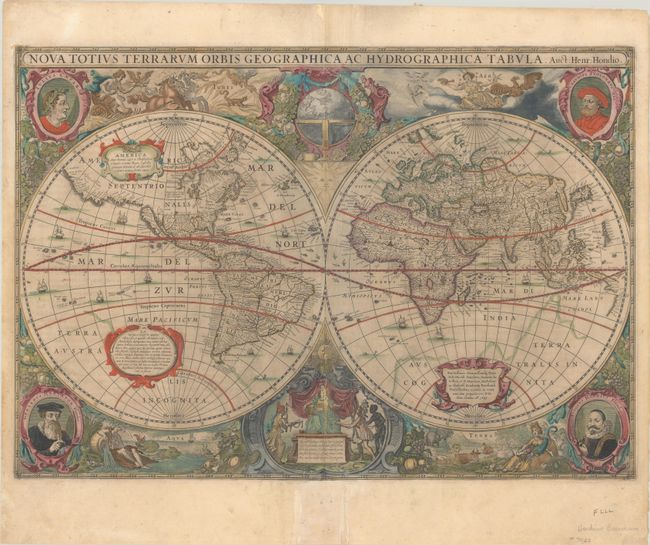
Henricus Hondius created this baroque-style world map when he updated the Mercator Atlas in response to competition from the Blaeu publishing firm. The map features hemispheres surrounded by voluptuous representations of the four elements: Fire by Apollo driving the Sun's chariot across the sky; Aeros, the goddess of Air, surrounded by clouds and birds; Mother Earth, surrounded by animals and the earth's bounty; and Water represented by a Siren and sea monsters. Tucked between the hemispheres are a celestial globe with the figure of the sun at top, and a scene of Europa receiving tribute from Asia, America and Africa with a figure of the moon at bottom. Four portraits fill the corners: Julius Caesar, Claudius Ptolemy, Jodocus Hondius and Gerard Mercator. The scenes are all beautifully linked together with a rich garland of fruit, reminiscent of Dutch still life paintings of the period.
For geographical detail, Hondius presents California as an island and the northwest coastline extends to the west. The cleverly placed cartouche just above this northwestern coastline allows Hondius to avoid the question of a Northwest Passage. On the northeast coast of Canada, Queen Anne's forland (Baffin's Island) is shown, and Plymouth, which had been founded along the coast of Massachusetts in 1620, also makes an early appearance. Hondius raises doubt as to the existence of Terra Australis Incognita, which is only shown with a faint outline, and includes the recent Dutch discoveries on the Carpentaria coast of Australia. Other geographical myths remain, including the islands of Frisland and Brasil in the North Atlantic, and Lake Parime in northern South America.
French text on verso, published between 1639-58. This is the second state, with Johannes Jansson's name added at bottom center and the date updated to 1641.
References: Shirley #336; Van der Krogt (Vol. I) #0001:1C.2.
Condition: B
A dark impression with full contemporary color on a faintly toned sheet with printer's ink residue and minor soiling. A centerfold separation at bottom that enters 4" into the image has been archivally repaired with a sliver of the image replaced in facsimile (within the queen at bottom). There are archival repairs to several small tears along the edges of the sheet and to a 1.5" tear to the right of the portrait of Ptolemy. Remnants of hinge tape on verso.