
Current Auction
Lot 47
Current Auction

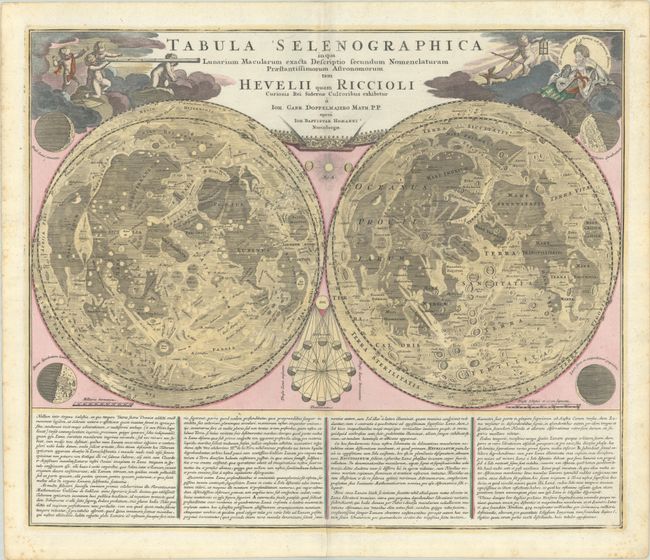
Classic Decorative Moon Map Showing Competing Systems of Lunar Nomenclature

"Tabula Selenographica in qua Lunarium Macularum Exacta Descriptio Secundum Nomenclaturam Praestantissimorum Astronomorum tam Hevelii quam Riccioli...", Doppelmayr/Homann
Subject: Moon

Period: 1742 (circa)

Publication: Atlas Coelestis

Color: Hand Color

Size:
22.8 x 19.1 inches
57.9 x 48.5 cm
Download High Resolution Image
(or just click on image to launch the Zoom viewer)

This is a magnificent double hemisphere map of the surface of the Moon. Both spheres depict the same side of the Moon and are filled with topography, using place names following the nomenclature of Hevelius (on the left) and Riccioli (on the right). Hevelius, author of the pioneering lunar atlas Selenographia (1647), named the features of the Moon after geographical features on the Earth, while Riccioli used the names of famous people and scientists. Doppelmayr copies Hevelius and Riccioli's original maps with great precision. Between the two spheres is a scheme of the phases of the Moon, and different lunar phases are represented in the four corners. The map is unique among lunar cartography for its use of decorative elements more commonly seen on terrestrial maps; above the hemispheres are cherubs using a telescope and Diana, the goddess of the Moon. According to Manasek, this is one of the only printed Moon maps in contemporary color published prior to the 19th century.

If you turn the map 90 degrees counter-clockwise and examine the sphere on the left, notice that the shaded area dominating the lower center of the sphere resembles the Mediterranean Sea. Hevelius named the landform in the middle of Mare Mediterraneum Sicilia, and the crater in its center M. Aetna. On Riccioli's hemisphere, Aetna is Copernicus, located just south of Mare Imbrium (Sea of Showers) in the vast Oceanus Procellarum (Ocean of Storms). For more than a century, lunar cartography was split between the nomenclature systems of Hevelius and Riccioli. This popular comparative map played a significant role in highlighting the two competing systems. Although Hevelius' system was influential, the cumbersome Latin names gave way to the easier to remember and more popular system devised by Riccioli - the system that left the possibility for scientists to someday have a lunar feature named for them!

Johann Gabriel Doppelmayr was a professor of mathematics at the Aegidien Gymnasium in Nuremberg. Doppelmayr and Johann Baptist Homann were frequent collaborators in producing celestial and astronomical charts for atlases. This chart was first engraved for Homann's Neuer Atlas (1707) and later appeared in the two major compilations of Dopplemayr’s works published by Homann Heirs: Atlas Coelestis in quo Mundus Spectabilis... (1742), and its revised edition Atlas Novus Coelestis... (1748). Read more about Doppelmayr's life and accomplishments here.

See also lot 748 for Nick Kanas's Star Maps - History, Artistry, and Cartography that describes this publication.

References: Kanas #7.8.3 & Figure 8.33; Manasek (Moon) pp. 166-71.

Condition: A

A nice impression in full contemporary color with a short centerfold separation confined to the bottom blank margin. Minor foxing is also limited to the blank margins.

Estimate: $1,000 - $1,300

Current High Bid:
$0

Reserve: Reserve Not Met
Next Bid: $500

Bid Increments
$500 - $999$50
$1,000 - $2,499$100
$2,500 - $4,999$250
$5,000 - $9,999$500
Terms & Conditions