Subject: Mexico City, Mexico
Period: 1655 (published)
Publication: Newe Welt und Americanische Historien...
Color: Black & White
Size:
6.9 x 6 inches
17.5 x 15.2 cm
This copper engraving is from a remarkable series of publications, illustrating voyages of discovery and travels of exploration to various parts of the world. The project was begun by Theodore de Bry of Frankfurt, in 1590 and was to continue for another 54 years. They became known collectively as the Grands Voyages (to America and the West Indies) and the Petits Voyages (to the Orient and the East Indies). De Bry died after the first six parts of the Grands Voyages were completed. The project was completed initially by his widow and two sons, Johann Theodore de Bry and Johann Israel de Bry, then by Johann Theodore's son-in-law, Matthaus Merian, in 1624.
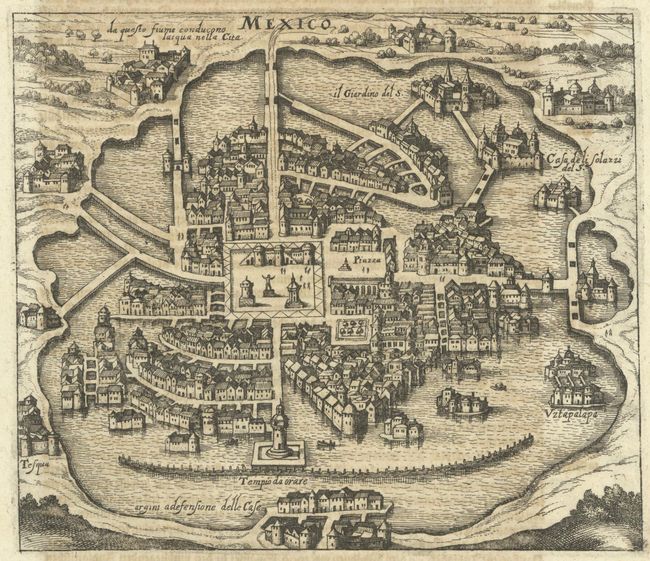
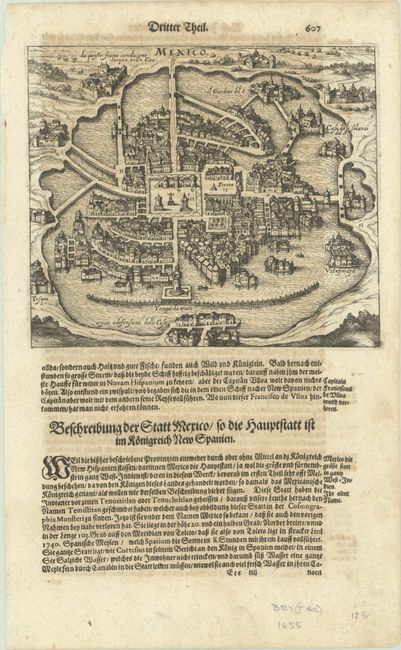
This handsome plan of Tenochtitlan (later Mexico City) first appeared in Part XIV of de Bry's Grands Voyages in 1630 (published by Merian), and was republished in Johann Ludwig Gottfried's Newe Welt und Americanische Historien, a collection of voyages. The collection was also known as Historia Antipodum. Matthaus Merian, de Bry's son-in-law and publisher for Historia Antipodum, was granted access to de Bry's copper-engraved plates. The plan is based on the one that first appeared in 1528 in Bordone's Isolario. It depicts the city before it was destroyed by Spanish forces and is perhaps based on sketches by Cortes. It depicts causeways into the city and canals that bring fresh drinking water in. The architecture has a distinctly European look. On a sheet of German text measuring 7.9 x 12.9" and accompanied by a second page of text (bifolium).
References:
Condition: B+
A sharp impression with light toning and show-through of text on verso.