Subject: Florida, Natives
Period: 1631 (published)
Publication: Historia Antipodum oder Newe Welt…
Color: Hand Color
Size:
8.6 x 6.2 inches
21.8 x 15.7 cm
This copper engraving is from a remarkable series of publications, illustrating voyages of discovery and travels of exploration to various parts of the world. The project was begun by Theodore de Bry of Frankfurt, in 1590 and was to continue for another 54 years. They became known collectively as the Grands Voyages (to America and the West Indies) and the Petits Voyages (to the Orient and the East Indies). De Bry died after the first six parts of the Grands Voyages were completed. The project was completed initially by his widow and two sons, Johann Theodore de Bry and Johann Israel de Bry, then by Johann Theodore's son-in-law, Matthaus Merian, in 1624.
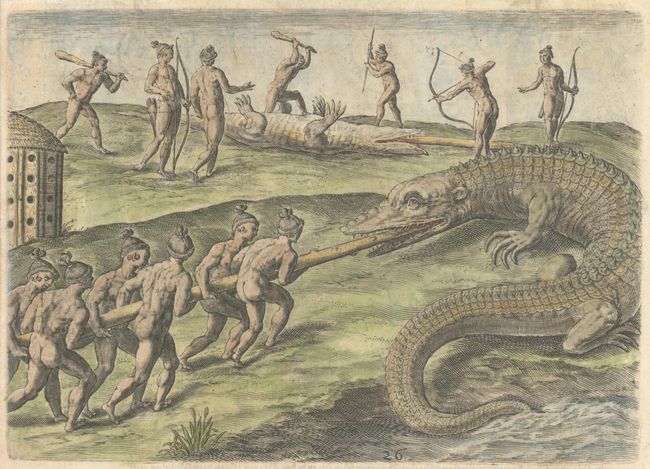
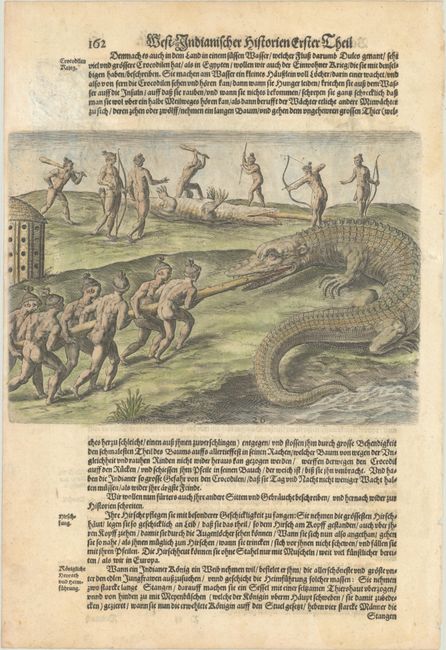
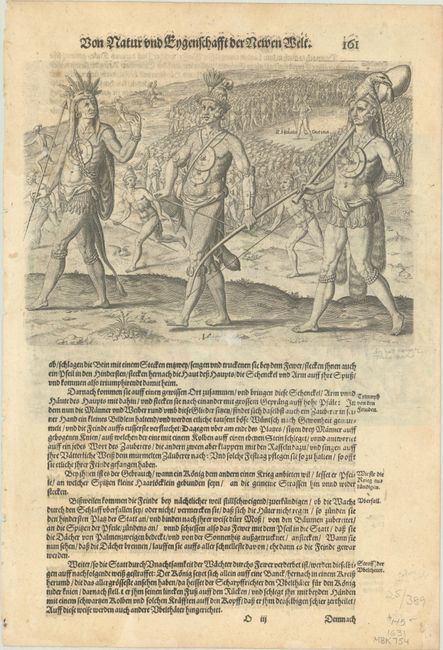
Two Florida engravings on one sheet, from an abridged version of de Bry's voyages. The first plate is one of the most wild and striking scenes in de Bry's Florida chronicle. It shows Indigenous Floridians hunting an alligator by plunging a tree trunk into its open mouth, flipping it over, and attacking its exposed stomach with clubs and arrows. The other engraving, on the sheet's recto, depicts Outina's army marching to war. Outina was a highly disciplined commander and had his soldiers surround him in formation while younger members of the tribe ran ahead to scout the enemy. The plates first appeared as Plate XXVI and XIV in Part II of de Bry's Grands Voyages in 1599, and were republished in Johann Ludwig Gottfried's Historia Antipodum, an abridgement of De Bry's voyages to America that incorporated much new material. Matthaus Merian, de Bry's son-in-law and publisher for Historia Antipodum, was granted access to de Bry's copper-engraved plates. On a sheet of German text measuring 9.2 x 13.5".
References: Van Groesen (De Bry's America) p. 113 & 127.
Condition: B+
A nice impression with light dampstaining that enters the image at top right.