Subject: Document - Germany
Period: 1945 (published)
Publication:
Color: Printed Color
Size:
22.4 x 15.9 inches
56.9 x 40.4 cm
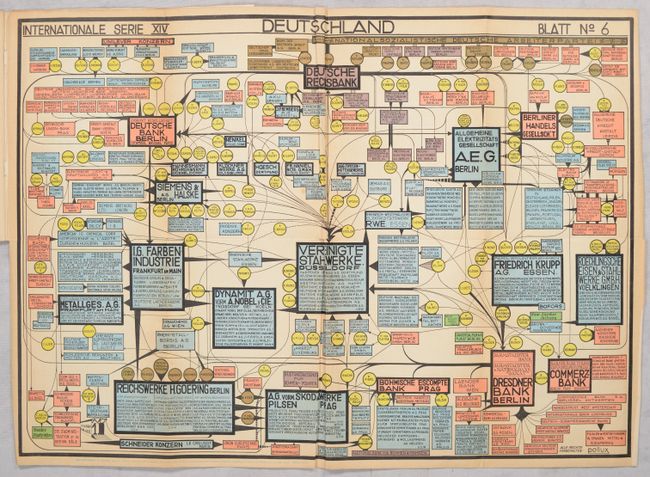
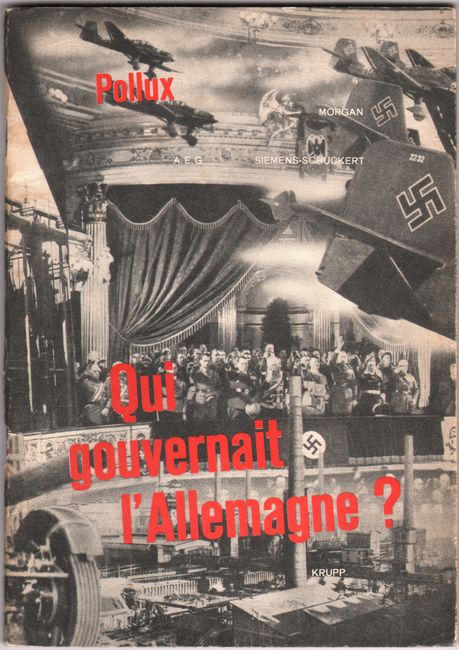
This graphic chart was created by Georges Baehler (alias Pollux) to illustrate the entanglements between various corporations and individuals that created a block of power in Germany, thus fueling the German Third Reich both politically and financially. Industrial corporations (denoted in blue), banks (red), mass media (green), individuals (yellow), and National Socialists (brown), are both intertwined and interdependent, creating a basis of control. The chart is bound into a pamphlet that answers the question "Who led Germany" by listing the companies and people who supported the Third Reich and were the "masterminds behind the scenes." While most of the attention during and after the war was on those who made the orders and pulled the triggers, the Third Reich was backed by numerous other players who assisted with money, power, supplies, etc. The intent of this pamphlet was to ensure that all parties were held accountable and punished for their part in the war.
This pamphlet, and several other similar periodicals, was published by Georges Baehler (1895-1982) under the pseudonym Pollux by a group he established called the Société d'Etudes Economiques (Association for Economic Studies). Baehler, a Swiss hydroelectric engineer, wrote under several pseudonyms over his career (Pierre Lenoir in France, Pollux in Switzerland, and Baumann in East Germany) with a focus on attacking concentrations of power and monopolies. This chart and pamphlet was also published in a German edition ("Wer Leitete Deutschland?") the same year, and a simplified, black and white edition of the chart was later published in "Criminels de Guerre! Derrière les Coulisses." All of these charts and pamphlets are very rare.
32 pages, with folding chart, bound in illustrated paper covers.
References:
Condition: B+
The map is issued folding with several mis-folds, light toning, a short fold separation at center, and a couple of tiny edge tears. The pamphlet has light toning and occasional foxing.