Subject: Southwestern United States
Period: 1810 (circa)
Publication: An Account of Expeditions to the Sources of the Mississippi...
Color: Black & White
Size:
18.6 x 18 inches
47.2 x 45.7 cm
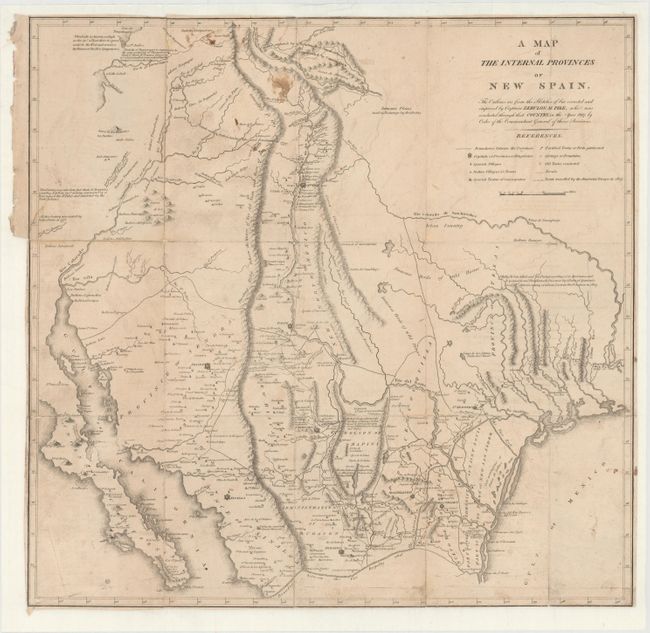
This map was included in Pike’s landmark report of the Southwest, describing his expeditions from 1805-1807. His book is one of the most important of all American travel narratives, and stands alongside those of Lewis and Clark as a cornerstone of early western exploration. The report itself (not included) contains accounts of Pike's travels to find the headwaters of the Arkansas and Red Rivers, his explorations along the Mississippi River, and his Spanish escort to Santa Fe, New Mexico and Chihuahua, Mexico.
Contained within the report are six maps, including this one focused on the Southwest and much of what is now Texas, New Mexico, Arizona, southern Colorado and northern Mexico. Shown are boundaries between provinces, capitals of provinces or kingdoms, Spanish villages, Indian villages or towns, Spanish towns of consequence, fortified towns or forts garrisoned, springs or fountains, old towns excavated, roads, and the route traveled by Pike’s troops in 1807. Additional features include the locations of numerous ranchos, mines, and notations such as "Immense herds of wild horses," "Immense plains used as pasturage by the Cibolas," and Indian tribe names. The map is the first to show Texas based on firsthand observations by an American soldier. A note in the Province of Texas states, "Philip Nolan killed and his Party consisting of 12 Americans and 8 Spaniards and French made Prisoner by a Party of Spaniards from Sn Antonio, many of whom I saw in the Provinces in 1807." This refers to Philip Nolan, the trader and freebooter killed by the Spanish in 1801; the Nolan River is named after him.
Pike was accused of plagiarizing Humboldt's map of New Spain, which he saw in manuscript form before it was published in 1811.
References: Holcomb (TX) pp. 124-25; TX GLO pp. 212-13; Wheat (TMW) #299.
Condition: B
Issued folding and now flattened and backed with heavy tissue to extend the narrow margins and to reinforce and repair numerous short and long fold separations. Light soiling and offsetting.