
The best place on the web to buy antique maps! Antique Maps, Globes, Charts,
Atlases & Vintage Graphics
Sign In | Search | Browse | Invoice  

Contact us  
Close: June 12th  Auction is closed. Bid Status
Terms & Conditions: English  Spanish  French  German 

Featured Items
Auction 144
(click on image or title to see details)


goto detail pageLot 2.  (Orbis Terrarum Typus de Integro Multis in Locis Emendatus), Visscher, 1652 . Visscher created two world maps in 1638-39, one double-hemispherical and one on Mercator's projection, both inscribed with his Latinised name, N.I. Pisactore. This is the first of the two maps, engraved by Pieter Goos. The cartography was based largely on Henricus Hondius' map circa 1630, Nova Totius Terrarum Orbis Geographica Ac Hydrographica Tabula. California is depicted as an island, and a large Nova Albion stretches out to the west. The Dutch discoveries on the Carpentaria coast of Australia are shown, and the faint outline of Terra Australis Incognita is still in evidence. Queen Anne's forland (Baffin's Island) is depicted on the northeast coast of Canada. In Visscher's edition, however, the large cartouche west of South America mistakenly identifies the dates of Christopher Columbus' and Amerigo Vespucci's discoveries of America 100 years later.

Outside of the hemispheres the decorative elements of Visscher's map are completely different from that of Hondius. Surrounding the hemispheres are twelve panels illustrating paired figures from various nations, four panels containing vignettes of the four seasons, and four panels depicting the elements. Tucked between the hemispheres are two celestial spheres. The elaborate artistry and interesting geographical detail make this a very desirable map. This is the fourth edition, with the date changed to 1652.(B+ ). Estimate: $14,000.00 - $16,000.00

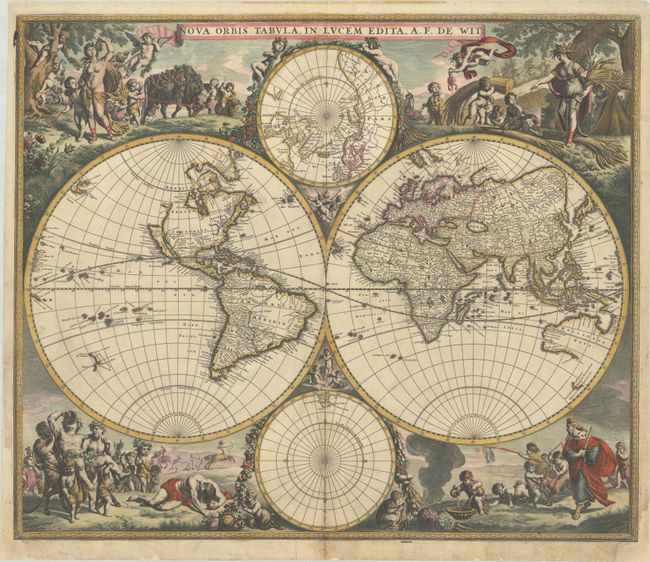
goto detail pageLot 3.  (Orbis Terrarum Tabula Recens Emendata et in Lucem Edita per N. Visscher), Visscher, ca. 1663 . This superb double hemisphere world map is surrounded by engravings including allegorical representations of the continents as well as native inhabitants and wildlife. Visscher's decorations were so popular several other cartographers copied them. Two diagrams depicting the Ptolemaic and Copernican theories of the solar system appear within the cusps of the hemispheres. The northwest coast of North America is greatly exaggerated with the fictional El Streto d'Anian, while California is shown as a peninsula. In the Pacific, Western Australia, Van Diemens Landt and a bit of New Zealand are also noted. This is the first state. Dutch text on verso.(B+ ). Estimate: $1,500.00 - $1,700.00

goto detail pageLot 19.  (A New & Accurate Map of the North Pole, with all the Countries Hitherto Discovered, Situated Near or Adjacent to it, as well as Some Others More Remote…), Bowen, ca. 1747 . Handsome polar map covering the region north of 50 degrees, closely based on Moll's map from 1705. It contains numerous notations concerning recent discoveries and the entire western part of North America is labeled Parts Undiscovered. There is also a notation of a New Discover'd Sea in Hudson's Bay that is totally fictitious. At bottom are lengthy English text panels describing the possibilities of still discovering northeast and northwest passages to Asia, which "would greatly shorten the length and lessen the expenses of East India voyages; and consequently be of considerable advantage to our British trade and navigation." Further paragraphs of text provide the names of the navigators consulted in the formation of this chart and a note that "the publick is in great expectation of new discoveries from the expedition of the Dobbs Galley and the California which passed by Yarmouth the 31st of May 1746 under convoy of the Loo of 40 Guns on their voyage to discover the N.W. Passage by Hudson's Streights." Nicely decorated with a compass rose and a title cartouche surrounded by ornamental scrolls and foliage. This is the second state of this map, with the plate number "No. 70" engraved at lower left center.(B+ ). Estimate: $450.00 - $550.00

goto detail pageLot 39.  (Jonathan Dickenson Ramspoedige Reystogt van Jamaika na Pensylvania Nagespoord), van der Aa, ca. 1714 . This interesting map is oriented with east at the top. It covers the eastern seaboard from Massachusetts through Florida to Cuba, Hispaniola and Jamaica. It illustrates the travels of Jonathan Dickinson from Jamaica to Philadelphia in 1696-7. Dickinson, a Quaker merchant from Port Royal, Jamaica, was shipwrecked on the southeast coast of Florida. The party, which included Dickinson's wife and infant son, was held captive by Indians for several days. They then traveled on foot up the coast, through numerous hostile Indian villages, to St. Augustine. The Spanish authorities then sent them by canoe to Charlestown, South Carolina, where they were able to find passage to their original destination, Philadelphia, Pennsylvania. The story of their harrowing ordeal was first published by the Society of Friends in 1699 and appeared in numerous editions and translations between 1700 and 1869. Published in van der Aa's compilation of early voyages of exploration.(B ). Estimate: $650.00 - $750.00

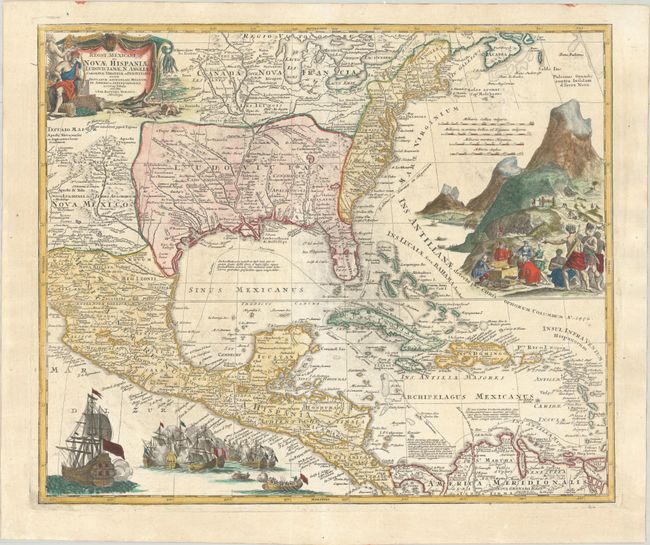
goto detail pageLot 40.  (Regni Mexicani seu Novae Hispaniae, Ludovicianae, N. Angliae, Carolinae, Virginiae et Pensylvaniae...), Homann, ca. 1720 . This superb map covers the region from the Great Lakes and Nova Scotia through Central America, the Caribbean and Venezuela, and from New Mexico (naming Taos and Santa Fe) to the eastern seaboard. The map is based largely on Delisle's map of 1703 (Carte du Mexique et de la Floride), depicting the social, political, and economic outcomes from the War of the Spanish Succession, also known as Queen Anne's War. The British colonies are shown confined east of the Appalachians and extending south almost to St. Augustine, deep into Spanish-claimed territory. The map itself is filled with settlement place names, Indian tribes and villages. In present-day Texas, Corpus Christi and El Paso (el passo) are noted. Sea routes of treasure fleets from Vera Cruz and Cartagena to Havana and Spain are outlined. Richly embellished, a fine title cartouche depicts two native figures with items to trade, such as hides and blankets. In the Atlantic, there is a large scene of extensive gold mining operations, with Indians bringing their treasures to fill the Europeans' chest. Off the Pacific coast of Mexico is yet another opulent engraving of a raging sea battle, reminiscent of the battles fought in Queen Anne's War.(B+ ). Estimate: $1,500.00 - $1,800.00

goto detail pageLot 56.  (Carte de la Louisiane Cours du Mississipi et Pais Voisins…), Bellin, 1744 . This interesting map first appeared in the journal of Pierre Francois Xavier Charlevoix, a French Jesuit historian and traveler who traveled throughout the French possessions in North America. The map covers from the Great Lakes through all but the tip of Florida, and from New Mexico and the Rocky Mountains through the eastern seaboard. The information in the west includes the road from Mexico City to Santa Fe and the routes of St. Denis and De Soto though Texas. The Riviere du Nord (Rio Grande) has its headwaters in the upper left corner, only a few miles from the Missouri River. There is great detail of Indian villages, trading agencies, forts, mines, villages, and colonial settlements. Bellin based the map on Guillaume Delisle's landmark map of 1718. While covering the same area, Bellin's map incorporates much new information from Charlevoix and other French explorers, particularly in the depiction of lakes and rivers and additional place names. Sometimes overlooked because of its similarity to Delisle's map, this map occupies an important step in the cartographic history of North America.(B ). Estimate: $800.00 - $1,000.00

goto detail pageLot 58.  (Carte Generale des Etats-Unis de l'Amerique Septentrionale, Renfermant Aussi quelques Provinces Angloises adjacentes…), Crevecoeur, [1787 ]. An uncommon map of the early United States and the first printed map to name Frankland. Also known as Franklinia, it is shown here just west of the border of North Carolina, named Pays de Frankland. In 1785 settlers in western North Carolina and what would become eastern Tennessee organized a state government to be named in honor of Benjamin Franklin. Congress turned down their appeal but the state maintained a legislature and governor until 1788. This ephemeral state appears on only a small number of maps. The 14th state of Vermont is named and noted in the key at right, with a notation in French that it was "not yet accepted in the confederation." Virginia is shown in a strange configuration and there is a square-shaped region denoted as Pays de Kentukey. Engraved by Pierre Francois Tardieu.

Crevecoeur was a French-born surveyor who settled in New York, where he produced this classic collection of twelve essays that reflected on the nature of American life, particularly its customs and manners. His description of bountiful American lands spurred many French people to immigrate to America. Howes says that Crevecoeur's work is a: "Description of American life of great influence in attracting European immigration in the post-revolutionary period. As literature unexcelled by any American work of the eighteenth century."(B+ ). Estimate: $300.00 - $375.00

goto detail pageLot 59.  (Carte Generale des Etats de Virginie, Maryland, Delaware, Pensilvanie, Nouveau-Jersey, New-York, Connecticut et Isle de Rhodes Ainsi que des Lacs Erie, Ontario, et Champlain…), Crevecoeur, [1787 ]. This is an updated French edition of Evans' rare and important map of the Middle Colonies that was first published in 1755. It was produced for St. John de Crevecoeur's book and includes some additions in New England, but fewer than the extensive additions of Pownall's 1776 reissue, according to McCorkle. Engraved by Pierre Francois Tardieu.

Highly detailed, the map covers the frontier, not just the better known populated areas of the states. It extends to include Lakes Ontario and Erie, and the St. Lawrence River to Montreal. The map randomly uses French or English for the scores of place names, while most notations and the legend are in English. A large inset at upper left "Esquis se duresse de la Riviere de l'Ohio" shows the course of the Ohio River to the Mississippi and up to Lakes Michigan and Huron. The French had better knowledge of the Great Lakes area as evidenced by additions on this map not found on the original Evans. For example, the Portage of Chikago, Fort Erie, and St. Louis are shown and the Niagara River valley contains more detail of the watershed in the region. De Crevecoeur also included updated information in New England particularly in Vermont, where Dartmouth College, Putney, Bennington & Westminster are located. Kentucky is erroneously named as a state and there are early references to important cities in the region - Louisville, and Leestown, which was the first Anglo-American settlement on the north side of the Kentucky River and is now part of Frankfort. The map names Indian tribes and a legend explains their status: Extinct; Nearly extinct; and those that are Still considerable.

Crevecoeur was a French-born surveyor who settled in New York, where he produced this classic collection of twelve essays that reflected on the nature of American life, particularly its customs and manners. His description of bountiful American lands spurred many French people to immigrate to America. Howes says that Crevecoeur's work is a: "Description of American life of great influence in attracting European immigration in the post-revolutionary period. As literature unexcelled by any American work of the eighteenth century."(B ). Estimate: $1,000.00 - $1,300.00

goto detail pageLot 61.  (Nova Anglia Septentrionali Americae Implantata Anglorumque Coloniis Florentissima), Homann, ca. 1730 . This handsome map shows the English colonies of Nova Anglia and New Jarsey and the Dutch colony of Novum Belgium - Nieuw Nederland - New Jork. It covers the region from Delaware Bay to Eastport, Maine. Numerous soundings and navigation hazards are noted along the coastlines. Oversized lakes appear in the interior of New England and New York, notably Lake Champlain (which is grossly misplaced) and Sennecaas Lacus. Cape Cod and Cape Ann are both depicted as islands and Boston Harbor is exceedingly large. The fictitious region of Norumbeag is placed in present-day Maine at the head of Penebrock Bay. Various Indian tribe names are identified on the map, as are numerous colonial settlements along the coastlines and rivers. The cartouche depicts a European sea captain negotiating with an Indian chief. They are surrounded with trade goods, alluding to the natural wealth of the region.(B+ ). Estimate: $1,500.00 - $1,700.00

goto detail pageLot 68.  (Partie de la Coste de la Louisiane et de la Floride depuis le Missisippi jusqua St. Marc d'Apalache), Bellin, 1744 . This important early chart of the Gulf Coast covers from New Orleans and the Mississippi delta to St. Marks River & Apalachicola Bay. The shoreline is still somewhat speculative but many harbors, inlets, bays & rivers are indicated along the coast. The Mississippi delta is well represented including the English Turn on the Mississippi River (Detour des Anglois). Shown mostly as a vast grassland, two areas noted as forests suitable for lumber are located near the abandoned French Fort de la Boulaye. Numerous Native American tribes and villages are located and the Choctaw road to Natchez is partially shown in the upper left corner of the map. The map was drawn from manuscript sketches brought back to Paris by Pierre Francois Xavier de Charlevoix, a Jesuit Priest who traveled through the region from 1720-1722. Charlevoix's account was extremely influential in future decisions made by Thomas Jefferson with regard to the Louisiana Purchase and the exploration of the west.(A ). Estimate: $1,100.00 - $1,400.00

goto detail pageLot 73.  (Cote Nord-Ouest de l'Amerique Reconnue par le Cap.e. Vancouver. 1e Partie), Vancouver, [1799 ]. This is the French edition of an important, large-scale, chart featuring the coastal topography from Bodega Bay to the mission at St. Domingo on the Baja. The track of Vancouver's exploration in 1792-93 is shown complete with soundings. Spanish missions and forts are located along the coast. The map is one of the best early maps of the Channel Islands and provides excellent coastal topographical information. The large insets of the entrance to San Francisco Bay and the port of San Diego are among the earliest obtainable examples of maps focusing on these two bays. During the summers of 1792-94, George Vancouver and the crew of the British naval ships Discovery and Chatham mapped the western coast of North America from Baja California to Alaska. Vancouver's voyage was the last, and longest, of the great Pacific voyages of the late eighteenth century. Taking the art and technique of distant voyaging to a new level, Vancouver eliminated the possibility of a Northwest Passage and his remarkably precise surveys completed the outline of the Pacific.(B+ ). Estimate: $1,400.00 - $1,700.00

goto detail pageLot 86.  (Carte des Isles Sandwich), Cook, [1784 ]. Although the first printed map of Hawaii is credited to Captain James Cook, it was prepared for publication by Lieutenant Henry Roberts, who prepared all of the maps for the three-volume narrative of Cook's final voyage. Roberts drew the map from a now-missing survey by William Bligh (of Mutiny on the Bounty fame) who was Sailing Master on the HMS Resolution. The map is a landmark in Hawaiian cartography and provided the basis for all subsequent mapping of the islands. The routes of the Resolution and the Discovery around the islands are carefully traced with nice topographical detail on each island. A large inset of La Baye de Karakakooa (Kealakekua Bay) is featured with details of soundings, navigational hazards and the anchorages of the two ships, and quaint depictions of houses, palm trees, and fields inland. Cook spent his last few weeks in Kealakekua Bay before dying in a confrontation with natives on February 14, 1779. This example is from the first French edition of Cook's voyages, A Voyage to the Pacific Ocean, which appeared the same year as the original English edition. Engraved by Benard from Henry Roberts' chart.(B+ ). Estimate: $800.00 - $1,000.00

goto detail pageLot 92.  (Plan de la Baie et du Havre de Casco et des Iles Adjacentes…), Sartine, 1779 . This curious chart of Casco Bay on the Maine coast was drawn by Captain Cyprian Southack and reissued by Antoine Sartine for the French Navy in 1779 during the American Revolutionary War. The map contains a number of inaccuracies, showing misshapen islands off of Portland Harbor and an inaccurate coastline from Portland to Small Point. The chart includes a dotted line course called Channel Way entering the Bay at Cape Elizabeth, weaving through the islands, and exiting at Small Point. Interestingly, the anchorages in the English edition were mistakenly interpreted by the French copyist as symbols for currents. The seal of the Depot de Marine is at top right.(A ). Estimate: $1,000.00 - $1,200.00

goto detail pageLot 93.  (Carte de l'Ile de Nantucket, pour les Lettres d’un Cultivateur Ameriquain), Crevecoeur, [1787 ]. This early copper engraved map of Nantucket includes a legend identifying thirty-two different sites. In addition to the detail in the legend, the map locates Sherburn, Full Mill and Isle de Tuckanuck. Engraved by Pierre Francois Tardieu.

Crevecoeur was a French-born surveyor who settled in New York, where he produced this classic collection of twelve essays that reflected on the nature of American life, particularly its customs and manners. His description of bountiful American lands spurred many French people to immigrate to America. Howes says that Crevecoeur's work is a: "Description of American life of great influence in attracting European immigration in the post-revolutionary period. As literature unexcelled by any American work of the eighteenth century."(B+ ). Estimate: $1,400.00 - $1,700.00

goto detail pageLot 94.  (Carte de l'Ile de Martha's Vineyard avec ses Dependances…), Crevecoeur, [1787 ]. This rare copper engraved map covers Martha’s Vineyard, the Elizabeth Islands and a portion of Cape Cod. On the Vineyard, details include roads, natural features, towns and villages, and two meeting houses. Also locates Tidsbury Wood Land south of Tidsbury Town, Eel Pond, Peat Swamp, Squidnoket Pastures, and Cape Pog Pond. The legend at upper right identifies ten features on the map with more information. A most desirable and early map of Martha's Vineyard. Engraved by Pierre Francois Tardieu.

Crevecoeur was a French-born surveyor who settled in New York, where he produced this classic collection of twelve essays that reflected on the nature of American life, particularly its customs and manners. His description of bountiful American lands spurred many French people to immigrate to America. Howes says that Crevecoeur's work is a: "Description of American life of great influence in attracting European immigration in the post-revolutionary period. As literature unexcelled by any American work of the eighteenth century."(B+ ). Estimate: $1,400.00 - $1,700.00

goto detail pageLot 101.  (Audience de Guadalajara, Nouveau Mexique, Californie, &c.), Sanson/Mariette, ca. 1667 . This map was first published in 1656 and introduced the so-called second Sanson model of California as an island. This depiction shows a small peninsula (Agubela de Cato) above the island, two bays along the island's northern coast and two new place names, Tolaago and R. de Estiete. Sanson actually based this on information from the less well known map by Luke Foxe, but it was this map that influenced many other cartographers throughout the rest of the century. On the mainland there are new Indian tribes identified in the region of the R. del Norte, which flows southwest from a large inland lake.(A ). Estimate: $1,000.00 - $1,200.00

goto detail pageLot 148.  (Septentrionalium Regionum Descrip.), Ortelius, [1598 ]. Ortelius based this influential map on the work of earlier authorities including Mercator, Zeno and Magnus. Of particular interest are the mythical islands of Brasil, Frisland, Drogeo, Icaria, and St. Brendan. Part of Mercator's imaginary polar continent is depicted with a Latin note that it is inhabited by pygmies. Iceland (Islant, Thule) is basically unchanged from Mercator´s map of Europe from 1554 with the shape originated by Zeno. Greenland is separated from Europe by a wide sea and a portion of North America appears in the upper left corner with the name Estotilant. The map is adorned with a variety of very inventive creatures including a half-man, half-sea creature playing a lute. This is the fourth state, with stippling added behind the lettering in the sea. French text on verso with page number 103.(A ). Estimate: $2,400.00 - $3,000.00

goto detail pageLot 155.  (Dartmouth. To the Right Honorable George Lord Dartmouth, Mr. Generall of his Majesty’s Ordnance &c.), Collins, ca. 1693 . This great chart shows the city and harbor of Dartmouth at the entrance to the River Dart on England’s south Devon coast. A lovely compass rose orients the chart with north pointing to the right. There are bays, castles, mills, and other places named along the coasts, as well as soundings, anchorages, shoals, and navigational hazards depicted in the waters. The chart includes three large landfall approach views providing navigational bearings for approaching Dartmouth, as well as an inset of Tarr Bay within a vine-style border. This chart is typical of Greenville Collins' work with a highly decorative title cartouche flanked by putti and fish counterbalanced by an equally decorative mileage scale with additional references to the fishing industry in the region. The title cartouche includes a dedication to George Legge, First Baron of Dartmouth, who died two years before the chart was first published and was succeeded by his son, William Legge. Engraved by F. Lamb.

In 1681 Capt. Greenville Collins (fl.1669-1694) an officer in the Royal Navy was appointed by the Admiralty to make a complete survey of the coasts of Great Britain. Prior to this date the charts used by English mariners were copies of Dutch charts that had many inaccuracies. The task of surveying the entire coasts was formidable and took about 7 years, at the end of which only 46 surveys were finally used in an atlas titled "Great Britain's Coasting-Pilot Being a New and Exact Survey of the Sea-Coast of England," which was first published in 1693.(A ). Estimate: $900.00 - $1,100.00

goto detail pageLot 163.  (Verschiedene Reisen des Auctoris), Seligmann, ca. 1749 . This fascinating map was originally drawn by George Edwards (1694-1773), an artist, naturalist and ornithologist who is most famous for his beautiful bird engravings published in his "Natural History of Birds" in 1743. Edwards' publication was immediately popular, and was subsequently republished in several editions, including this German edition published between 1749-76 with plates re-engraved by Johann Michael Seligmann. The map shows Edwards' journeys between 1716-1730 to study his beloved birds and other natural creatures, including Holland in 1716 and again in 1730, Norway in 1718, and France from 1719-21. The map is embellished with several findings of natural history from his other travels abroad. At top is the large beak of an Egyptian Ibis. Below are two life-size drawings of stag beetles from Borneo in the East Indies. And at bottom is the Least Humming Bird from Jamaica with its egg, also drawn life-size. Edwards' interest in natural history was boundless and this wonderful map, with its curious combination of cartography and the natural world, is a rare and very attractive curiosity.(A ). Estimate: $250.00 - $350.00

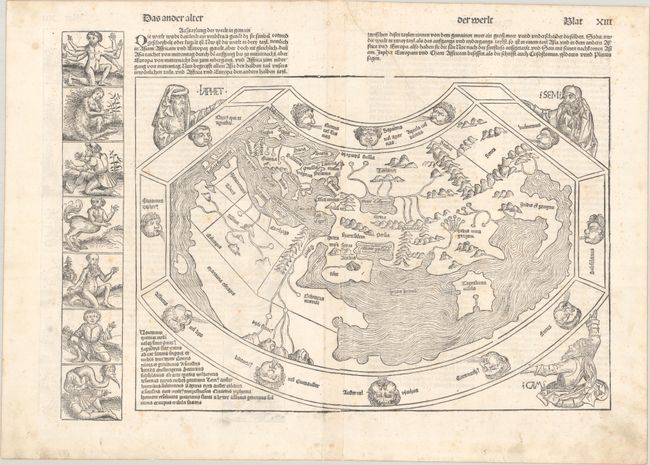
goto detail pageLot 208.  (Folio LXIII - Destruccio Iherosolime), Schedel, [1493 ]. This double-page woodcut illustration of the city of Jerusalem is one of the more detailed views in the Nuremberg Chronicle. It is an imaginary view of the destruction of Jerusalem, with towers toppled and the Temple of Solomon engulfed in flames. It is actually a synopsis of six separate holocausts described in the text. Major points in the city are identified with text notations. Of special interest, in the upper left of the image, are the figures of Jesus and Satan shown on top of Mount of Satan. On a full sheet of Latin text (24.0 x 17.2"), with additional text and illustrations on verso.(B+ ). Estimate: $1,400.00 - $1,800.00

goto detail pageLot 209.  (Palestinae sive Totius Terrae Promissionis Nova Descriptio Auctore Tilemanno Stella Sigenens), Ortelius, ca. 1570 . This is Ortelius' first map of the Holy Land. It covers the region from the Nile Delta to Lebanon, and focuses on the desert of the Exodus. Ortelius' map was based on Tilemanno Stella's map of 1557 that became the prototype for the modern cartography of the Holy Land. Stella adapted the coastline and Dead Sea from the configuration of Jacob Ziegler's map of 1532. But here, Ortelius rounds Stella's angular Dead Sea and the Gulf of Aqaba. The map is richly decorated with two elaborate, neoclassical cartouches. The unique square compass rose showing magnetic declination was also copied from Ziegler, but here is curiously shown up-side-down. The sea is teaming with five ships (three of which are shown with canons firing) and three sea monsters. This example is from the first of three plates used for the Theatrum. Latin text on verso with page number 51, published between 1570-1573.(A ). Estimate: $1,000.00 - $1,200.00

goto detail pageLot 240.  (Iaponiae Insulae Descriptio. Ludoico Teisera Auctore), Ortelius, [1598 ]. This landmark map was the first map of Japan published in a European atlas. Ortelius received the map from Ludovico Teixeira, a Portuguese Jesuit cartographer and mathematician. While Teixeira had not personally traveled to Japan, he obviously had access to Japanese sources as the map presents the first reasonably accurate and recognizable depiction of the island nation with numerous Japanese place names. Korea appears as an island tapering to a point labeled Punta dos ladrones. The map is elegantly embellished with three large galleons, two elaborate cartouches and a boldly engraved border. This influential map was to become the basis for many other cartographers' maps of Japan for more than fifty years. French text on verso with page number 108.(A ). Estimate: $3,000.00 - $3,750.00

goto detail pageLot 257.  (Carta Particolare che Comincia con li Stretto di Gibilterro e Finisce con il Capo Gruer nella Barberia Occide…), Dudley, [1661 ]. An elegant sea chart of the coastline of Morocco from Tanger to Agadir, and of Spain from Cadiz to the Strait of Gibraltar. Numerous place names are shown along the coast, as well as anchorages, soundings, and shoals. The chart extends west to include the islands of Madeira and Selvagens, and short navigational notes are included throughout. The chart is embellished with Dudley's trademark calligraphic style, a strapwork title cartouche with the head of a classic sea serpent, a large compass rose, and two sailing ships. This is the second edition with Lo. 6o. added to the title cartouche. Printed on two sheets, joined as issued.

Robert Dudley was the first Englishman to produce a sea atlas, Dell Arcano del Mare (Secrets of the Sea). A skilled mathematician and navigator, Dudley was exiled from England and settled in Florence where his atlas was published. He introduced a totally new style for sea charts in the atlas with only lines of latitude and longitude and no rhumb lines. The charts were meticulously compiled from original sources and were both scientific and accurate for the time. This important atlas was the first sea atlas of the whole world; the first to use Mercator's projection throughout; the earliest to show the prevailing winds, currents and magnetic deviation; and the first to expound the advantages of Great Circle Sailing. In an introductory leaf found in one copy in the British Library, the engraver states that he worked on the plates in seclusion for twelve years in an obscure Tuscan village, using no less than 5,000 pounds of copper for the printing plates. It was only issued in two editions and the maps are rarely seen on the market.(A ). Estimate: $950.00 - $1,200.00

goto detail pageLot 265.  (Mer de Sud, ou Pacifique, Contenant L'Isle De Californe, les Costes de Mexique, du Perou, Chili, et le Detroit de Magellanique, &c.), Mortier, ca. 1693 . While focused on the Pacific Ocean, this uncommon and dramatic sea chart covers nearly all of North America and a good deal of South America. It prominently features the island of California using the information from Luke Foxe's map of the region with bays on the northern coast, an array of islands in the Mer Vermeio, and the large Agabela de Gato peninsula shown in the Pacific Northwest. The island of Japan is shown with an amorphous Hokkaido named Terre d'Eso ou Yedso from the de Vries expedition. Partial coastlines are mapped for New Zealand, Northern Australia, Tasmania and New Guinea.

Le Neptune Francois was the most expensive sea atlas published in Amsterdam during the latter part of 17th century. This map is from the expanded atlas with the Suite du Neptune Francois, ou Atlas Nouveau des Cartes Marines, a group of maps copied by Nicolas Fremont d'Ablancourt from manuscript maps collected by the Portuguese crown; a rare occurrence because Portugal was notorious for keeping their geographical sources secret. Printed on two sheets, joined as issued.(B+ ). Estimate: $3,500.00 - $4,250.00

goto detail pageLot 266.  (Magnum Mare del Zur cum Insula California / De Groote Zuyd-Zee en 't Eylandt California), Renard/De Wit, ca. 1715 . Second state of De Wit's superb mariner's chart of the Pacific Ocean showing the island of California, published by Renard. California is depicted with an indented northern coast on the second Sanson model, copied from Pieter Goos' Paskaerte van Nova Granada, en t'Eylandt California from 1666. The important Dutch discoveries are noted on the northern coast of Australia, Carpentaria, New Guinea, Anthoni van Diemens Landt (Tasmania) and New Zealand. North of Japan the discoveries of De Vries are shown along with disembodied sections of 't Land van Eso and Compagnies Lant. De Wit has omitted the chain of islands and hypothetical coastline of the southern continent that is commonly found on maps of this period. Instead he has presented a fairly good view of the few known Pacific Island groups. The chart is adorned with rhumb lines, sailing ships, sea battles and a compass rose. The allegorical title cartouche features a portrait of Magellan, cherubs, and Neptune with a female consort riding a brace of sea-horses. This chart covers an area from the equator to 50°N.Lat. and south to 45°S. Lat.(B+ ). Estimate: $3,000.00 - $3,500.00

goto detail pageLot 269.  (Carte des Nouvelles Decouvertes au Nord de la Mer du Sud, tant a l'Est de la Siberie et du Kamtchatka, au'a l'Ouest de la Nouvelle France), Santini, [1776 ]. This is the authorized Venice edition of this cornerstone map of Alaska and the Pacific Northwest by Delisle/Buache. It depicts the discoveries of the Russians in the early 18th century, including the tracks of Bering's first and second voyages, Joseph Nicolas Delisle's voyage with Capt. Tchirikow in 1741, the track of De Frondat's voyage from China to California in 1709. The route of the Spanish Galleons from Acapulco, Mexico to Manilla, Philippines in 1743 are also shown. These ships regularly carried immense quantities of gold and treasure along the route, until they were captured by Commodore George Anson in June 1743.

The west coast of North America is entirely fictitious north of Cap Blanc with an enormous Sea of the West, Lac Valasco, and Isle of Bernarda. A network of rivers and lakes making up most of a Northwest Passage is derived from the apocryphal voyages of the Spanish Admiral Bartholome de Fonte. Title in rococo cartouche flanked by a native of Kamchatka in the upper left corner and a native of Louisiana in the upper right corner.(B+ ). Estimate: $1,600.00 - $1,800.00

goto detail pageLot 279.  (Australia and New Zealand), Imray, 1894 . An impressive blue-backed chart on four joined sheets showing Australia and New Zealand, and extending to include parts of Java and New Guinea, the Solomon Islands, New Hebrides, New Caledonia and Fiji. This highly detailed chart includes both topographical and hydrographical information, including tides, currents, soundings, lighthouses (marked with red and yellow), and navigational notes. The interior of Australia is left blank, but there is good detail of rivers, topography, towns and counties along the coasts and in New South Wales and Queensland. At bottom left are two large inset charts of Bass Strait and Port Philip. The chart also includes three landfall approach views of: 1) Mount Egmont (Mount Taranaki), New Zealand, as seen from a New Plymouth anchorage; 2) Point Nepean at the entrance to Port Philip; 3) and the Snares Islands. This is one of the largest and most comprehensive charts of the South Pacific area designed for navigation in the late 19th century. The chart was published by James Imray & Sons, in London and is typical of Imray's desire for accuracy indicated by his note at the base of the chart that says: "The publisher respectively requests communications that may tend to the improvement of this or any other works." Adjacent to the publisher's imprint at bottom center is a blue stamp indicating that the chart was "Corrected to 1894." The chart is on four sheets, joined and attached to wooden rollers at both sides. On verso is a gold label stating: "Chart No. 197 Australia, New Zealand, and Ancient Islands" with a marked price of 12s.

This chart is very rare. We have not found any examples of this chart being offered for sale in the past 30 years, and have only found one other example, dated 1897 and housed in the National Library of Australia.(B+ ). Estimate: $1,600.00 - $1,800.00

goto detail pageLot 283.  (Carte de la Nle. Zelande Visitee en 1769 et 1770. Par le Lieutenant J. Cook Commandant de l'Endeavour Vaisseau de la Majeste), Cook/Benard, [1774 ]. This is one of the most important maps in New Zealand's history and the first complete map of the two islands' coastlines. The chart was made during Cook's first voyage and shows the track of the Endeavour with dates and soundings. The interior reflects the mountainous topography. From the French edition published by Hawkesworth and engraved by Benard.

Capt. James Cook sailed from England in 1768 on his ship the Endeavour on his first round-the-world voyage visiting islands in the Pacific before sighting New Zealand's north & south islands and the strait that divides them, which he named Cook's Strait. Between 1769-1770 Cook sailed around both islands, proving that they were independent of the Great Southern Continent, which was what navigators had believed since Abel Tasman discovered the land mass in 1642. This finely engraved map was taken from a sketch brought back to London by Cook in 1771, which was published in English in London by Cadell & Strahan in 1773, and in French in Paris in 1774.(B+ ). Estimate: $1,600.00 - $1,800.00

goto detail pageLot 292.  (Limon di Salerno Monstroso), Volkamer, ca. 1710 . Johann Volkamer was a wealthy Nurnberg merchant who owned magnificent orchards and a fine orangery. At his expense, he employed a number of draughtsmen and engravers to execute depictions of his fruit, which he published under the title of Nurnbergische Hesperides, with over 100 plates. Unlike other 18th century botanical engravings are set against plain backgrounds, Volckamer filled in the lower section of his plates with views of palaces, gardens, landscapes and seascapes in Germany, Austria and Italy. These delightful additions make the Volckamer engravings especially attractive. This engraving shows a giant lemon from Salerno, Italy with a quaint view of a city street below.(A+ ). Estimate: $550.00 - $700.00


World & Globes | West Hemisphere | No. America | Canada | United States
Latin America | Atlantic & Arctic | Europe | Asia | Africa | Oceania | Prints | Incunabula | Books